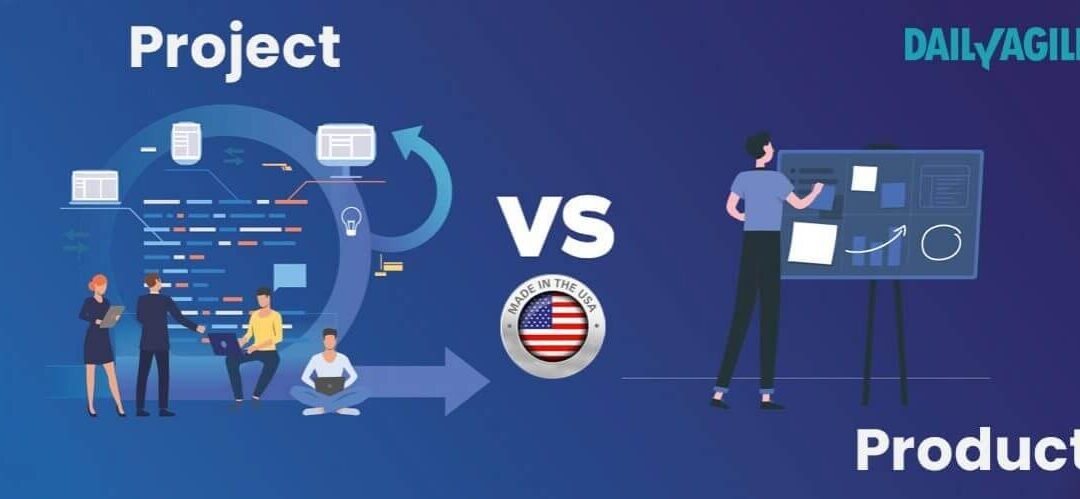
Project Vs. Product Management: Everything You Need to Know
According to a project definition provided by the Project Management Institute (PMI), a project is characterized by a specific set of operations to accomplish a singular goal, often including employees who don’t usually work together. It has a definite beginning and ends in time, is unique in itself and not classified as a routine operation. At the end of a project, all involved teams are either disbanded or assigned new projects with new members.
Contrarily, a product can be a good, service, system, application, etc. solely created by resolving business problems to deliver specific benefits to suit targeted customer or business requirements. Usually, products are maintained by a group of individuals who regularly work together, often bringing in others if needed. Essentially, a product can only be developed within the context of a sprint and each sprint is considered a project (Ref. ScrumGuide 2020). In large complex product multiple sprints can be developed during a product’s life cycle. Unlike a project, agile product mindset does not required upfront scope definition for 12 to 24 months. So, Product mindset allows flexibility to adjust and adapt market changes. Product mindset will allow customer to be in charge of what is being build and when can they have it. Requirements of buyers evolve naturally over time.
Therefore, product development is a continuous process of delivering new features over time to successfully meet changing user needs. Also Product development will improve quality, reduce cost of change, and delivers business value earlier. Being agile requires primary shift in mindset from project teams to move to products which support Lean and Agile methodology. Mindset and culture are top priority for agile organization, that are looking to achieve business agility.
Difference between Product and Project management:
| Area of Focus | Project Management Mindset | Product Management Mindset | Primary Reasons |
| Lifecycle | “Definite start & stop dates”Multiple programs with clear stop & start dates are grouped together | “Continuous evolution”Regular and continuous process of Plan-Do-Check-Act | Continuous and ongoing feedback loops enable businesses to come up with short-term solutions while moving towards long-term goals. |
| Key Metrics | “Getting it right”Making modifications to existing plans and focusing on Estimates vs. Actuals. Focus is output not outcome. | “Learning & improvising”Task related learning opportunities in which employees improvise as they keep working. Focus is outcome not output. | Get-it-right approach is not suitable for continuously evolving work places, which is why more flexible metrics with improvisation has better results. |
| Leadership | “Accountability rests with the top leaders”Leaders assign managers, and individuals to complete tasks. “Command And Control hierarchical structure” | “One self-organizing Team”Multiple self-organizing teams pull in work as per their capacity, supported by agile leaders who foster collaboration and agility.Lean and Agile Leadership. | If accountability is concentrated in the top leadership, team members don’t feel they contributed to the success. Only leaders continue to climb while everyone else stagnates. |
| Governance | “Rigid & strict” Typically detailed checklists and standards to ensure people adhere to the “right” process.Check the Box Mentality. | “Adaptive and practical”Minimal guard rails for consistency are set up, often revisited in real time when needed. | Rigid governance makes it challenging to adapt to real-time feedback. Employees often feel disempowered to make impactful decisions. |
| People | “Interchangeable resource”Employees are exchangeable and individual contributors can be easily moved from one project to another. | “Dedicated team members”People work as part of dedicated teams, working in pairs or swarms. In case individuals need to switch in or out, the team has to re-assesses capabilities and adjust goals accordingly. | Money can motivate an individual to a certain extent. Ownership on the other hand can ignite passion in individuals in ways that money alone cannot. |
| Risk | “Upfront analysis”Upfront analysis has a limited scope – only adequate to get a pilot started. It is one big, comprehensive assessment to identify and mitigate all possibilities of risk. | “In-time resolution”Impediment resolution happens via frequent check-ins and synchronization across multiple teams. | Most upfront assessments look for infinitesimal risks that can lead to litigation and gloss over the risks that can happen in every project. |
| Requirements | “Problem solving through order taking”The project team necessarily waits for orders from stakeholders and focuses on documenting the solution without interacting with the end user. | “Problem solving through user interaction”Product teams identify problems and needs via user interaction, with user stories as placeholders for conversations. | Ideas that fail to solve real problems and needs will create new requirements that have been validated early in the process before investment in a particular solution. |
Table 1: Difference between product and project management:
Responsibilities of Project Managers vs Product Managers
The job description of a Project Managers chiefly involves overseeing plans that are previously approved and developed. They often manage both resources and schedules to attain objectives. Also in most companies project manager’s role perceived as more of a highly paid administrator e.g. they schedule meetings, take notes, track budget, and create reports in multiple colors, create project schedule in MS projects. In fact, often project managers a highly paid scapegoat at the end when projects fail.
However, they put comparatively lesser input in defining and prioritizing both long term and short term business goals. No wonder there is NO Project Manager in Scrum and as some of you think, Project is not equal to Scrum Master. Boost your career with advance product management skills with Advanced Certified Scrum Product Owner and Certified Scrum Professional – Product Owner certifications.
Contrarily, Product Owner/Manager are the owner of product outcome and drives the vision/direction throughout the product life cycle. These professionals list down initiatives according to their priorities and make strategic decisions regarding what gets built in the highest priority order. In fact, they are also regarded as the min-CEO of product lines, they primarily focus on business objectives, positive outcomes, and measurable goals at a sustainable pace.
Conclusion:
Ensure your organization is speaking Product vocabulary and not stuck with old traditional project management. If you haven’t transitioned from Project to Product, start now. To get a jump start on your transition, checkout our Agile course offerings and consider role-based trainings and set your teams for success.