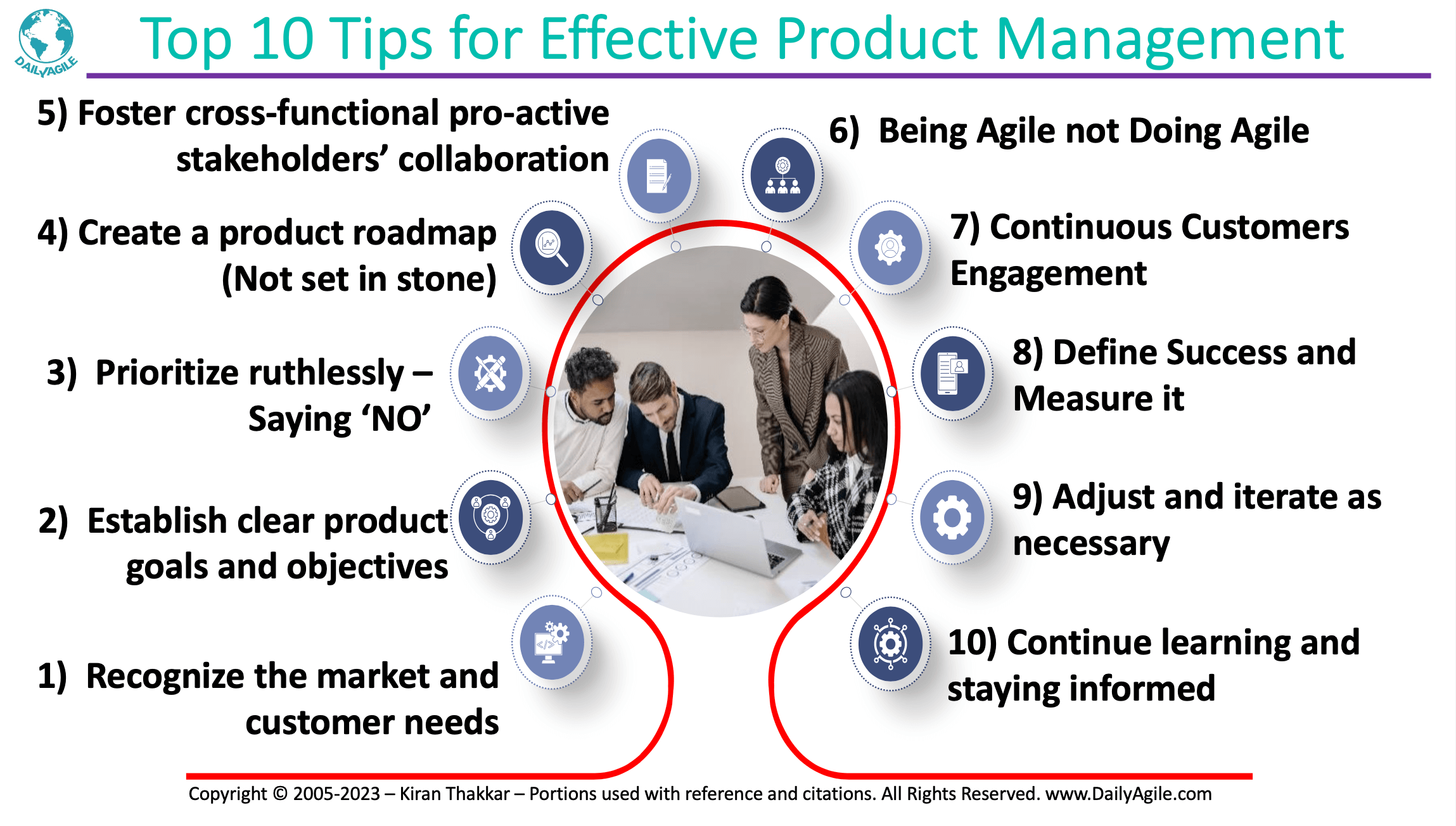
1) Recognize the market and customer needs:
- Learn as much as you can about your target market, including the needs, wants, and pain points of the customers.
- To help you make decisions about your products, conduct market research, consumer interviews, and data collection.
- Make sure you are well-respected by your stakeholders and that you possess business domain experience while maintaining a balance with tech savvy.
2) Establish clear market segment, product goals and objectives:
- Set definite, quantifiable objectives for your product. Make sure these objectives are SMART (specific, attainable, relevant, and time-bound) and align them with the overarching business objectives.
- Define clear OKR (Objective Key Results) and communicate at all levels.
- Educate and align on how to assess agile metrics compare to traditional metrics.

3) Prioritize ruthlessly, Re-prioritize based on new information:
- Product managers frequently must balance competing requests with little resources.
- Order features, improvements, and bug fixes according to their value to customers, business implications, and strategy alignment.
- To help you prioritize your product backlog items – epics, features, or user stories ensure you define your prioritization criteria and use one of the many prioritization techniques.
- I hear from almost every company we don’t have enough resources – that’s not your problem, your problem is poor prioritization practices
- Practice how to say ‘NO’ without alienating your primary stakeholders.

4) Create a product roadmap:
- Creating detailed product road with exact dates is considers anti-agile practice, however some companies require you to submit some kind of plan before your budget is approved. OR you are still practicing in hybrid ‘water-scrum-fall’ model.
- Create a product roadmap that specifies the MVP (Minimum Viable Product), long-term strategic course of your product.
- Your vision, significant projects, and significant milestones must be communicated.
- Review and update the roadmap frequently considering shifting market conditions, client feedback, and corporate priorities.
5) Foster cross-functional pro-active stakeholders’ collaboration:
-
- In my experience it is pity to learn that many product managers don’t even know all their stakeholders as they have invested in identifying and classifying their stakeholders.
- Identify your stakeholders and in agile framework, you may need to revisit your stakeholder identification and classification process every sprint.
- Product Managers must consider frequent regular collaboration with stakeholders from engineering, design, marketing, sales, education services, HR, Finance, Security, Regulatory, Compliance, Vulnerability, and customer support are among those that product managers frequently collaborate with.
- To assure alignment and promote the creation of successful products, promote open dialogue, teamwork, and information exchange within these teams on a regularly basis.

6) Apply agile frameworks:
- To increase efficiency and flexibility in product development, embrace agile approaches like Scrum, Scrum and Kanban (ScrumBan), xP (eXtreme Programming), DevOps, DevSecOps, Lean Thinking.
- Organize work into manageable sprints, give features priority based on business value, and iterate depending on user input.
- Review progress frequently, gain frequent feedback from users, make plan adjustments, and keep refining your product.
7) Engage your Customers early and often:
- I still hear from companies – Oh we have UI team, QA Team, BA team, Front End team, Back-end team, API team, if you have such silos, you are still stuck in functional model and you are simply delaying critical customer feedback. You must consider creating a feature teams not Component team. Read more about feature teams.
- Engage customers in conversation throughout the lifecycle of the product.
- To comprehend their demands and validate product decisions, conduct usability testing, obtain feedback, and conduct user research.
- Ask for input from customers frequently, then utilize it to iterate and enhance your offering.
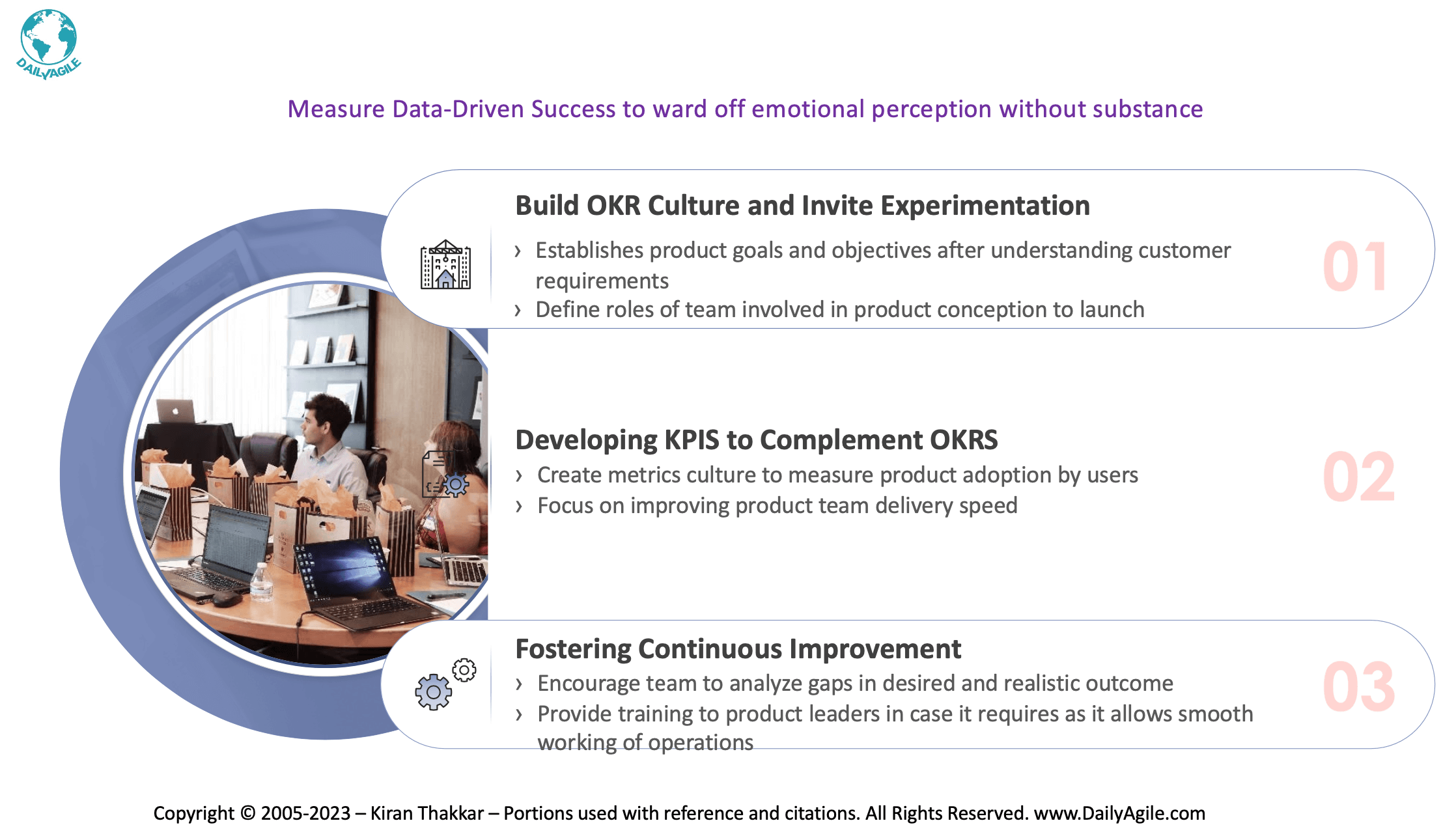
- Create OKRs (Objective Key Results) and key performance indicators (KPIs) that are in line with your product’s objectives.
- Track the progress of your product by regularly monitoring key parameters.
- For data collection and user behavior insights, use solutions like analytics platforms and customer feedback systems.
- There are tons of metrics you can create however I recommend four most important metrics that matters in agile are: Flow time – from request to delivery, Customer Value with Customer satisfaction, Quality of the product, and Team Satisfaction.
- Markets and products change with time. Be receptive to suggestions and data-driven insights that may call for adjusting your product plan.
- Adopt an experimental mindset and take lessons from both successes and mistakes.
- As necessary, iterate and pivot to provide value for your customers.
- Invest in yourself and entire product management group
- Keep abreast on market developments, new technology, and product management best practices.
- Participate in industry forums, attend conferences, and interact with the product management community.
- To be productive in your position, constantly learn new things and adjust your talents.

8) Assess performance and success:
9) Adjust and iterate as necessary:
Continue learning and staying informed:

Reminder Tip: Ensure you are an empowered product owner/manager and have a time to do your job.
Conclusion:
Act as a mini-CEO of your product and two most important aspect of product management are passion for your product and communication.
Remember that these best practices should be adapted to your specific product, organization, and market dynamics. Experiment, learn from your experiences, and tailor your approach to suit the unique needs and challenges you face as a product manager. Are you ready to up-skill your career with Certified Scrum Professional – Product Owner workshop (CSP-PO)? Pleas check our CSP-PO schedule?
Check out our Scaling Agile Framework (SAFe) Certifications from Scaled Agile.
Also check out our Certified Scrum Professional – Scrum Master (CSM-SM).
Are you a business analyst and wants to kick start your career? Consider our IIBA certifications such as ECBA, CCBA, and CBAP trainings.
Are you ready to be a best Product Owner, now is the time to earn CSPO – Certified Scrum Product Owner or Advanced Certified Product Owner (A-CSPO) or Scaled Agile Framework POPM workshop with us. Check out our upcoming agile workshops at: www.dailyagile.com/all-courses
Thank you for reading and if you have additional questions or need 1-hour free webinar for your team/company, please contact Kiran Thakkar at: info@dailyagile.com.