Although there is considerable overlap, the phrases are frequently used synonym of each other. Product manager and product owner responsibilities differ, nevertheless. In this article, we’ll compare the duties and responsibilities of a product owner vs product manager and examine the differences between the two roles.
What distinguishes a product owner (PO) from a product manager (PM)?
There are various opposing definitions of product managers and product owners at the most fundamental level. But to the extent that there is agreement on the key distinction between product managers and product owners, it is as follows:
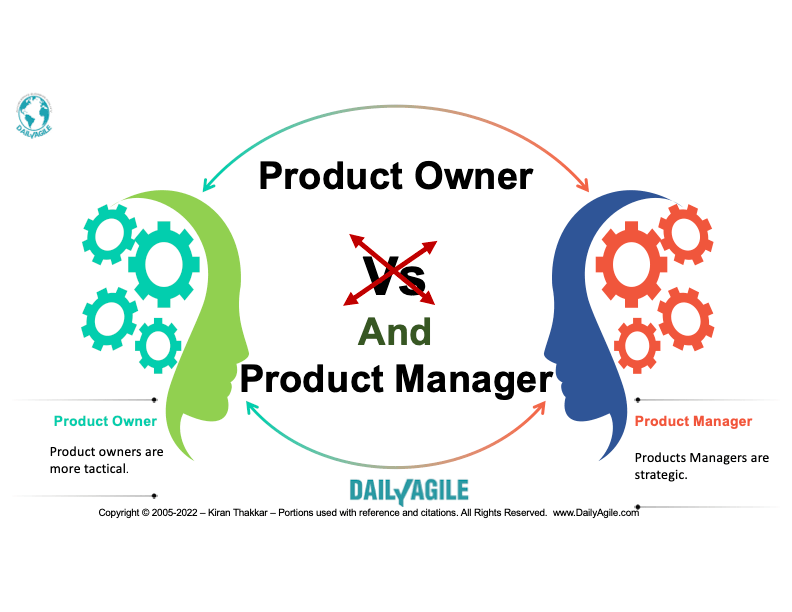
Product Managers focus more strategic activities in large enterprise. They concentrate on the market, shaping a product, craft a winning strategy, corporate goals, Business Case, and the product’s vision. Product owners are more tactical, and you’ll generally find them in agile frameworks as part of the scrum team. PO collaborate with cross-functional agile teams to carry out tactical needs by converting the product manager’s strategy into concrete activities.
This article will go into each of these positions and look at how they differ and overlap.
Product Manager Role Description
- Product management is responsible for strategically directing the creation, introduction to the market, ongoing maintenance, and enhancement of a company’s products. The long-term strategy, the product vision, market trends, and the discovery of new opportunities are the main responsibilities of a product manager.The product manager’s job is strategic in nature and is “focused on the long-term vision for the product, on observing trends in the marketplace, on identifying new potential outcomes or strategic themes to be supported by the product, on supporting the sales/adoption of the product, and on ensuring the product meets the needs of the value stream(s) the product is involved with.” The product manager often engages in the following activities:
- Product promotion
- Assisting with product sales
- Financial planning
- Long-term planning
- Customer service
- Assisting the agile teams that delivers product increments
Product Owner Role Description
The product owner role may be traced back to the Scrum agile framework, according to Scrum Guide, “The Product Owner is accountable for maximizing the value of the product resulting from the work of the scrum team.”
As a result, today’s product owners are mostly found in companies that employ the agile development methodology.
“The Product Owner is also accountable for effective Product Backlog management, which includes:
- Developing and explicitly communicating the Product Goal.
- Creating and clearly communicating Product Backlog items.
- Ordering Product Backlog items; and,
- Ensuring that the Product Backlog is transparent, visible, and understood.
The Product Owner may do the above work or may delegate the responsibility to others. Regardless, the Product Owner remains accountable.”
“For Product Owners to succeed, the entire organization must respect their decisions. These decisions are visible in the content and ordering of the Product Backlog, and through the inspect-able Increment at the Sprint Review.
The Product Owner is one person, not a committee. The Product Owner may represent the needs of many stakeholders in the Product Backlog. Those wanting to change the Product Backlog can do so by trying to convince the Product Owner.” (Source: Scrumguides.org, Scrum Guide 2020 version)
When you have multiple scrum teams working in parallel to build a large product in Scaled Agile environment, you have product managers, product owners, and product management team. In larger portfolio, you will need regular PO Synchronization to ensure you are working together to maximize value.
Product owners are more tactical, and they collaborate closely with scrum teams to guarantee that the appropriate functionality is quickly built. Product Owner is part of the scrum team. The product owner will effectively communicate the product manager’s broad vision into specific criteria.
To accomplish this, they collaborate extensively with a variety of product stakeholders, including those who are not customers, such as those in finance, security operations, support, audit, and other departments. Product Owner’s responsibilities are:
- Being present at scrum team events
- Managing Product Backlog
- Order Product Backlog
- Clearly explain Product Backlog Items (PBIs)
- Clearly communicate product vision and product goals
- Providing feedback on the product increment
Let’s See Product Owner Vs Product Manager side by side

Final Words:
The argument over whether these two responsibilities are just two distinct facets of the same position or where the line between a product manager’s and an owner’s role should depend on your organization structure, organization hierarchy, product size, number of scrum teams you need to build a product. In a smaller organization, Product owner may be responsible for both Strategic and tactical responsibilities.
What is crucial, though, is that your product organization has a team structure that supports your process and that the Product Managers and Product Owners on your team are fully aware of the duties and objectives specific to their positions.
Are you looking to train your product owners, product managers and agile teams? Partner with DailyAgile and let us help you accelerate business agility, check out our upcoming workshops at: https://dailyagile.com/all-courses/. Contact us, if you are looking for free 1 hour webinar or agile questions and answer with your agile leaders. We wish you best luck in your agile journey.
By Kiran Thakkar, 1.800.758.AGILE(2445)
Next Steps – Accelerate your product management function
Attend one of our interactive CSPO, POPM, and A-CSPO today and get a jump start in establishing Product Management mindset in your organization.