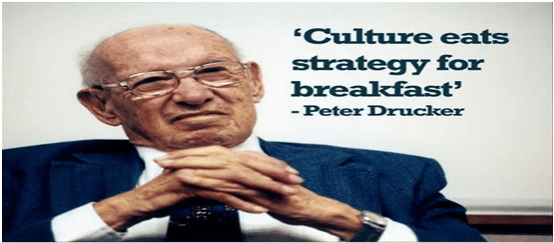
Peter Drucker, has arguably been described as “the founder of modern management”.
This quote, by Drucker in 2006, implies that the culture of your company, or organization, always determines success regardless of how effective your strategy may be.
When he said that Culture Eats Strategy for Breakfast, Drucker pointed out the importance of the Human Factor in any company. No matter how detailed and solid your strategy is, if the people executing it don’t nurture the appropriate culture, your projects will fail.
All too often managers, and management by definition, get hung up on the term “Corporate Culture”. They see this as a question of “How do we make our people happy?”
Culture, in today’s work environment, isn’t about comfy chairs and happy hours at the office, or who brought the donuts today. Or more topical, having Face Masks made with your Organizations Logo printed on them.
Rather, it’s more about the ways your Team Members act in critical situations, how they manage pressure and respond to various challenges and deadlines, and how they treat partners and customers, and more importantly, each other.
Company culture happens, whether you work on it or not. It represents the core of the company, or organization, and most of it is created by the business founders, and often by the Product Stakeholders—sometimes unknowingly. The actions of the founders and executives speak louder than their words in the process of culture creation.
Strategy focuses on resourcefulness and skillfulness, while Culture defines engagement, passion, and execution.
Drucker goes on to say “Knowing your culture means knowing what to expect from your team.”
Ken Schwaber, Jeff Sutherland, and the team founded ScrumAlliance in 2001.
All of these ideals that Drucker implied in his 2006 Quote, Culture Eats Strategy for Breakfast, are considered to have been among the cornerstones of what Ken, Jeff & the team incorporated into Scrum. As Scrum framework is based on lean thinking for solving complex problems, leaders need to understand culture and align their mindset to improve agility. With that in mind, it follows suit that a mature Scrum Team, including their ScrumMaster, understand their Team’s Culture. It is that understanding that helps them meet most, if not all, of their Team’s Goals, at the end of each Sprint.
Successful Implementation of an Agile Environment is more than just dictating a company, or organizations, Strategy to a Scrum Team, and then expecting them to go out and build a product.
Read Also : Benefits of good user stories.
Peter Drucker recognized, and pointed out, the Human Factor is just as important as the Business Needs, when creating a Strategy for a Product to be built by the Team(s). “I’m more interested in people than I am in how businesses work”.
So, there is no surprise that 1st Agile manifesto is we value “Individuals and Interactions over Process and Tools”.
When a Scrum Team is truly dedicated, cross-functional they embody the Human Factor that Drucker speaks about.
We are an Enterprise Agile coaching and training organization that offers world class education in Agile practices for IT and Non-IT professional teams. Our quality training content enables individuals and enterprise teams to develop advanced skills to meet their individual and business goals. We provide global customized private and onsite training as well as enterprise Agile coaching at your organization, or as a virtual session. DailyAgile is a certified Registered Education Provider (R.E.P.) with ScrumAlliance® and a Scaled Agile Silver Partner (SAFe).