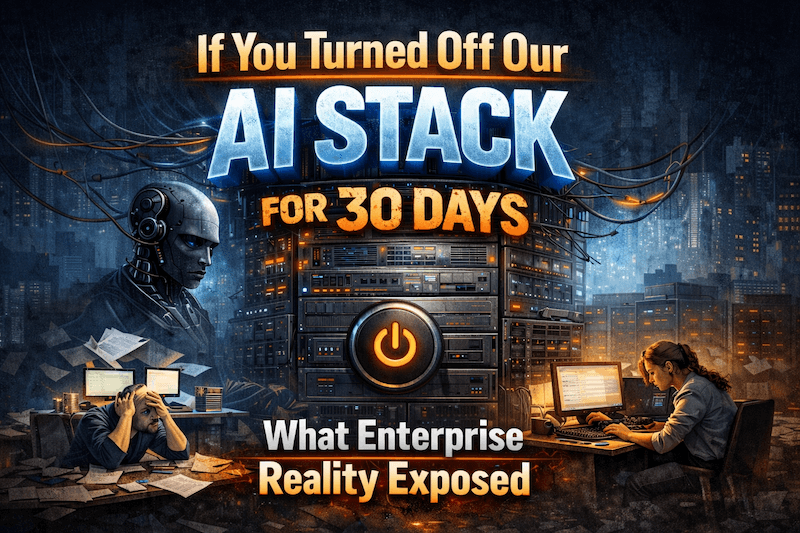
If AI assistance were suddenly restricted-not eliminated, but deliberately constrained-could your organization still operate with confidence, accountability, and clarity? By 2026, this is no longer a hypothetical question.
If AI Went Dark for 30 Days: The Enterprise Assumptions It Would Expose
Disabling AI for 30 Days: The Security Controls That Quietly Failed
Across industries, enterprises are quietly discovering that artificial intelligence has shifted from a productivity enhancer to an unexamined operating assumption. AI is now embedded in how organizations think, decide, communicate, forecast, and govern-often without deliberate design. This article explores what becomes visible when organizations operate under a 30-day AI constraint-a realistic scenario increasingly used during audits, regulatory reviews, security incidents, or governance resets-and what it reveals about true enterprise readiness.
What the Constraint Revealed: Enterprise Patterns, Not IT Problems
When AI support is constrained, the first cracks rarely appear in technology. They appear in organizational behavior.
1. Decision-Making Slowed-But Became More Explicit
Under normal conditions, AI compresses ambiguity. Summaries arrive quickly. Recommendations feel authoritative. Confidence appears high. Under constraint:
- Decisions took longer
- Assumptions were surfaced instead of hidden
- Trade-offs were debated rather than auto-accepted
- Accountability shifted back to named individuals
The organization did not lose intelligence-it lost synthetic certainty.
2. Knowledge Became Local Again
AI had quietly centralized access to institutional knowledge. When constrained:
- Subject-matter experts became bottlenecks
- Documentation gaps surfaced
- “Who actually knows this?” re-emerged as a critical question
This revealed a common enterprise blind spot:
AI had improved access to knowledge without strengthening ownership of knowledge.
3. Productivity Fell-But Not Where Leaders Expected
Output volume declined in some areas, but rework and review fatigue declined as well. Teams reported:
- Fewer corrections of AI-generated outputs
- More time spent reasoning, less time validating
- Greater confidence in final decisions, despite slower pace
The constraint revealed that speed had been masking cognitive overload, not eliminating it.
The Most Important Exposure: Human Capability Gaps
The most consequential insight from the 30-day constraint was not technical. It was human.
| Capability | What Became Visible |
|---|---|
| Analytical reasoning | Over-reliance on AI framing |
| Decision writing | Difficulty articulating rationale |
| Risk judgment | Reduced confidence without AI cues |
| Systems thinking | Narrower mental models |
| Change leadership | Limited readiness to lead AI-augmented teams |
In many organizations, AI capability had advanced faster than human capability. This is not an AI problem. It is a learning and change problem.
Redefining Enterprise AI Readiness (Beyond Tools and Pilots)
Most organizations still define AI readiness in technical terms:
- Model accuracy
- Tool adoption
- Pilot success
- Cost optimization
The 30-day constraint revealed a more durable definition.
Enterprise AI Readiness Is the Ability to Operate Responsibly With or Without AI
| Dimension | Low Readiness Signal | High Readiness Signal |
|---|---|---|
| Decision-making | AI approval behavior | Human-authored reasoning |
| Knowledge | AI-retrieved facts | Curated institutional memory |
| Governance | Tool policies | Accountability clarity |
| Talent | AI users | AI-literate leaders |
| Change | Tool rollout | Behavior transformation |
| Resilience | Untested assumptions | Simulated constraints |
Why Training-Not Tools-Determines AI Outcomes
The constraint made one reality unavoidable:
AI does not transform organizations.
People trained to work with AI do.
Enterprises that recovered fastest during AI-restricted periods shared common traits:
- Leaders understood AI limitations, not just benefits
- Teams had shared language around AI-assisted decision-making
- Change agents were equipped to guide behavior, not enforce tools
- Technical foundations were understood well enough to question outputs
This is where AI-native education becomes decisive.
Building AI-Ready Organizations: Capability Over Hype
In-Person, Enterprise-Scale Change Requires Human Alignment
DailyAgile’s AI-Native Foundations and AI-Native Change Agent certifications are designed specifically for this reality:
- Not tool training
- Not hype cycles
- But behavioral, organizational, and leadership readiness for AI-enabled enterprises. Check out our Virtual five-week AI foundations to breakthrough certified by Penn State University.
Delivered in-person at Penn State Great Valley, Malvern, PA campus or at your location, these programs focus on:
- Decision accountability in AI-augmented environments
- Organizational change patterns created by AI
- Scaling agility with AI, not around it
- Preparing leaders to govern AI responsibly
They address the exact gaps exposed by a 30-day AI constraint.
Why wait? Sign up today and master the art of AI leadership for lasting success.