Scrum is becoming one of the most popular approaches in the context of agile, which is growing worldwide. Now it’s spreading outside of the IT and software industry. Currently, most of the organizations are dealing with the component and feature team for completing most of the projects. Most organization design support component team. It is an important aspect to consider for organizations to accelerate business agility.
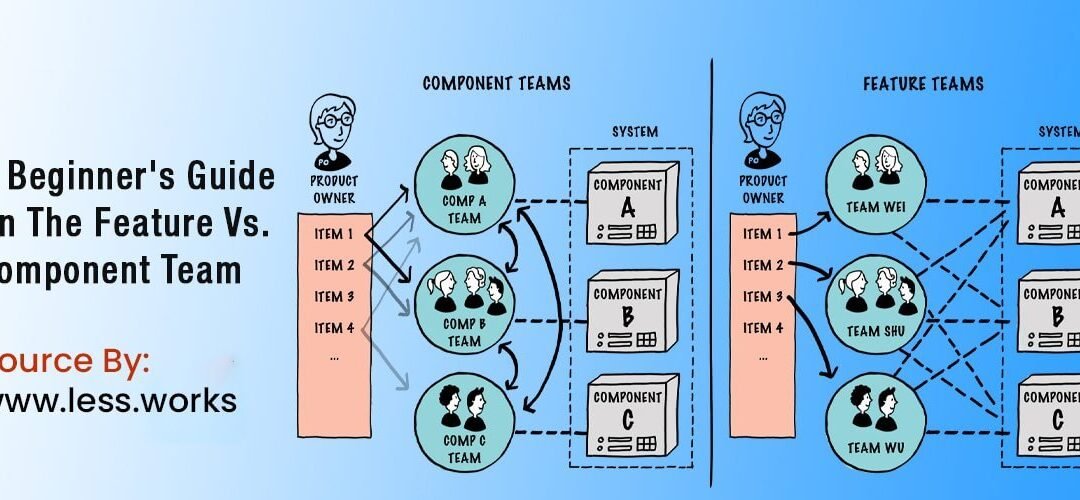
Source: less.works
So, in this article, you will find the process of understanding and the major difference between the feature & component teams. Whenever an organization needs more than one team for building a product, they should consider onboard feature teams in order to deliver value every sprint.
There are two different teams for the development of the product, which anyone can choose, and those are the feature team & component team! Therefore, it is necessary to make the right decision whether you are starting agile adoption or already in agile journey. In most scenarios, the feature team should be the right choice, but there are scenarios where organization may opt for a hybrid model. So, let’s help understand factors to consider & make the right decision which one is suited to your situation.
What is a Feature team?
A feature team is one that is known as the cross-functional & cross component team, which is responsible for building and providing end-to-end customer features or slice of a feature. This team plays a major role in the development and scaling of Agile. Every organization needs a feature team to get rid of plenty of problems. They target multiple specializations rather than targeting one silo part of the product.
This team works on value flow and reduces or eliminates dependencies. The feature team is organized, and they focus mostly on customer-centric functionality. The team is responsible for delivering the end to end-user value. This team increases flexibility by reducing the dependencies and sharing the team responsibilities.
What is a component team?
The component team is specialized team that is focused on the specific component or the set of components. Many organizes find it easy to create component teams around their current silo organization structure such as UI scrum team, API scrum team, QA scrum team and so on.
It may benecessary to hire or create a component team when the component has a unique legacy and provides deep technical and theoretical expertise. If the component has multiple internal and external systems, then a component also requires a team that has an idea of deep technical expertise. To start product development, most companies rely on the component team. It is just because they believe that a particular team can make effective changes on specific silo.
When should we prefer the feature team & component team?
When you want to reduce dependencies, multiple integration points, and silos in product development life cycle you should strongly consider onboarding a feature team. When your product needs some bigger changes, you are mostly dependent on the feature team rather than the component team. The features teams are mostly considered ideal if the product is brand new and in its initial stage. On the other hand, the feature team is also preferable if the product is rapidly growing and for the products that hold the extended life expectancy.
An organization should choose the feature team if they want to improve flow of delivery and want to work always on the most important and valuable items. There are some organizations that are making the transition from the component team to the feature team with cross-training, changing future hiring process, and pair programming.
Does the feature team perform better than the component team?
Yes, in most scenarios feature team does better than the component team. The feature team mostly focuses on the value of the business, and that’s why they follow the principles of agile. The feature team has better learning knowledge than the component team. The feature team has better knowledge because they work on every level of the technology stack.
So, due to this, the team flexibility increases, and the dependencies between the team reduce. This is why it reduces the waiting times. When it comes to the Feature team, they are more responsible for the end to end functionalities than the component team.
Major factors of the component team:
- The component teams are organized according to the technical layers
- This team requires a knowledgeable element for managing the project
- It minimizes the overall transparency due to limited view of the product
- All component team needs works together to complete the product lifecycle. They might be involved in different projects and shared across multiple project at the same time.
- Heavy focus on several levels co-ordination and integration required.
- The work is divided into the team depending upon the technical components
- The technical skills become unbalanced at a portfolio level.
Major factors of feature team:
- The features teams compliment their skills, they are major players, and they work together to fully complete features or a slice of features in the same sprint.
- In this team, the work is integrated according to the cross-component and cross-discipline every day.
- Each feature team member is skilled, and they know how to make the conversion for the releasable Increments through the product backlog.
- The team has divided the work based on the end-user functionality.
- There is better transparency in the team as compared to the component team.
- The feature team members have multiple skillset
A tabular representation of the difference between Features Vs. component
| Component team | Feature team |
| The component team is responsible for delivering the maximum amount of codes for their specific area of skills. The team mostly focuses on the productivity of the individual, and they try to improve this by implementing the feature of lower value. | The team is responsible for delivering the highest customer value Feature team’s focus is to deliver highest value item as early as possible. |
| It is easy to align component teams with traditional organization structure. | It requires organization level mind set change to create feature team with cross-functional, cross-component members. We are not talking about make huge organizational structure changes. |
| The team focuses on the growing organization. | The team focus on the smaller organization based upon the visibility and focus |
| The team support more of a waterfall development | This team supports the iterative development process |
| Individual member of the team has individual responsibilities. | All the responsibilities are shared between the team |
| They have the ownership of code individually. | The whole team shared the product code ownership |
| They focus on single specializations. | The team focus on the multiple organizations |
| The team follows the traditional way of organizing or developing a team. The team mostly works on the principle of Conway’s law. | The team follow the modern way of organizing or developing a team |
| The teams work with the practice engineers with a limited practice effect. In some cases, the component codes might be low quality. | The team works with the required multi-skilled engineers They make easy codes that are tested |
Summary: This article described the difference between feature and component team and how most organization design automatically leads them to start with component teams. So we recommend you go towards features, as they appear to deliver the highest value and efficacy of large-scale agile development. Feature teams also reduce dependencies, easier to manage, and increases value throughput with feature teams. Every organization’s design, culture, system defers based on product they are building. So, Agile product development must continually inspect and adapt and indeed reorganize, as necessary to follow the value that is driving the market.
Next Steps: Attend one of our interactive SAFe for Teams training or Leading SAFe Certification training to understand Team Topologies and effective ways of working within an Agile Release Trains.