Getting started with Lean Portfolio Management can be a challenging undertaking for portfolio leaders in any organization. Scaled Agile Framework® (SAFe®) Lean Portfolio Management (LPM) includes very well defined steps, processes, and guidelines for you to adopt LPM function. Let’s look at more details on what is LPM, why consider it and how to get started with it in your organization?
What is Lean Portfolio Management?
As per Scaled Agile Framework, Lean Portfolio Management (LPM) is a function with the highest level of decision-making authority and accountability for achieving overall better business outcomes. LPM is also one of the seven core competencies for organizations aiming to achieve Business Agility. Think of LPM as nervous system of an organization that allows organizations to connect strategy with execution. It does so by leveraging Lean and Systems Thinking approaches. Successful adoption of SAFe Lean Portfolio Management (LPM), requires commitment from organizational leaders.
Why consider Lean Portfolio Management?
In today’s global economy where digital disruption is a norm, traditional approaches to portfolio management simply do not allow you to compete. Lean Portfolio Management which is based on Lean-Agile approach is fundamentally different as it requires you to organize people around value and then execute work by long-lived Agile teams and team of teams. When used correctly with the support of senior leaders within the organization, Lean-Agile approach can result in significant improvement in Time-To-Market, Quality, Productivity and Engagement, which can be seen in the figure below.

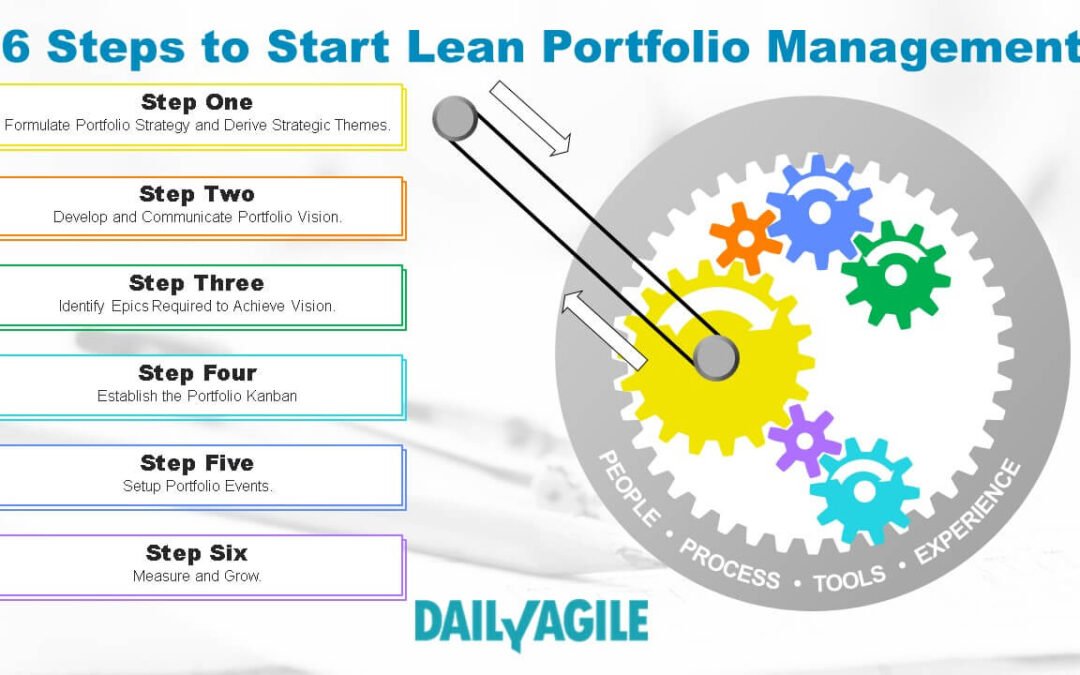
Here are the steps to get started with Lean Portfolio Management (LPM) and start realizing its benefits.
- Formulate portfolio strategy and derive Strategic Themes
- Develop and Communicate Portfolio Vision
- Identify Epics required to achieve vision
- Establish portfolio Kanban
- Setup portfolio events
- Measure and grow
Step 1: Formulate Lean Portfolio Strategy and Derive Strategic Themes
Portfolio strategy formulation requires collaboration among key portfolio stakeholders from business and technology including Enterprise Executives. Multiple input factors will need to be considered including customer feedback, core values, vision, mission, distinctive competence, financials and so on. When you analyze various factors and and develop strategy, consider following four questions:
- Where do we compete or which competitive arenas, industry, geography or market will we operate in?
- What unique value do we bring to our customers in those markets?
- What resources, tools and capabilities do we utilize to better serve our customers?
- How do we maintain competitive advantage and sustain our value?
These four questions will allow you to develop a clear strategy. One of the outputs of strategy formulation is Strategic Themes, which are differentiating business objectives and typically captured using Objectives and Key Results (OKR). It includes an inspirational objective and few key results that are measurable and can be used to track progress towards the objective.
Step 2: Develop and Communicate Portfolio Vision
Portfolio Vision is nothing but a future state of the portfolio. It provides long-term context to Agile teams and team of teams that are working on various solutions to achieve that vision. Vision statement inspires the team members to take charge and get engaged on the long term journey to achieve that future state. Here are few good examples of a vision from popular companies.
- Microsoft: We strive to create local opportunity, growth, and impact in every country around the world.
- LinkedIn: Create economic opportunity for every member of the global workforce.
- Disney: To be one of the world’s leading producers and providers of entertainment and information.
- Australia Department of Health: Better health and wellbeing for all Australians, now and for future generations.
Step 3: Identify Epics Required to Achieve Vision
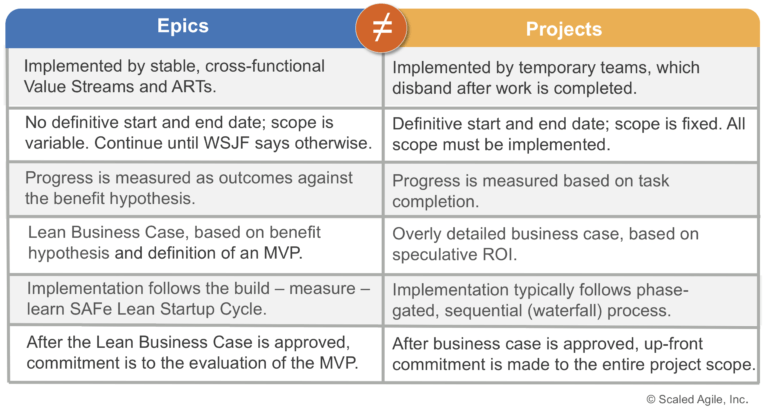
Epic is a significant development initiative that require substantial investment within a portfolio. Epics require a Minimum Viable Product (MVP) and an approval by Lean Portfolio Management for its implementation. You must be thinking that since an Epic is a significant development initiative, so how is it different than a traditional project? It is fundamentally different and following figure from Scaled Agile Framework, explains it very well.
Step 4: Establish the Portfolio Kanban
Portfolio Kanban allows you to visually see and manage the flow of the work from inception to implementation and completion. Although pretty straightforward and simple to implement Kanban board is a very powerful tool, as it allows you to identify improvement opportunities by visualizing the bottlenecks in each states. In addition to using Portfolio Kanban, provide execution support while leveraging decentralized decision making and intrinsic motivation of knowledge workers. Here is an example of a Portfolio Kanban as recommended by Scaled Agile Framework.

Step 5: Setup Portfolio Events
Provide governance support for budget, spending and compliance with following three events.
- Portfolio Sync – This event has a more of an operational focus than the strategic one. It provides insight into how the program execution is progressing. If needed, LPM can provide require support to achieve operational excellence. Recommended frequency is once a month.
- Participatory Budgeting – This event allows portfolio stakeholders to provide an input on how much funds to invest for which initiatives and so on. This input is considered by LPM, which makes the final decision on funding allocation. Recommended frequency is twice annually.
- Strategic Portfolio Review – This event has more of a strategic focus than the operational one. Primary focus in this event is to ensure that they are advancing to achieve portfolio vision. Recommended frequency is once every quarter.
Step 6: Measure and Grow
Relentless improvement needs to be in the DNA of the organization. Plan, Do, Check and Adjust cycle needs to be followed at all levels of an organization. Scaled Agile Framework provides core competency assessment that can be downloaded. It can be used to assess current state and future state to ensure that you identify key areas to improve and then focus on improving those areas.
Conclusion
Even though getting started with LPM can be challenging, there are few things you can do to make a smooth transition. Understand the basics of LPM, Build your guiding coalition team, Get the right resources, get the right training and start with a portfolio where you have a high probability of success. Once you prove the success in one portfolio, then replicate that success to other portfolios.
For insights on how SAFe LPM helps enterprises scale Agile, check out our latest blog: Navigating Agile at Scale.
Next Steps
For a structured learning experience, check out our interactive SAFe LPM Certification course today and get a jump start in establishing Lean Portfolio Management function in your organization.